Portland Ghost Bikes
Visual Motifs in the Ghost Bike Memorial
The modern bicycle memorials live in a secular world. Religious iconography is absent, instead replaced by a set of common, non-denominational motifs. For the purpose of this analysis I have segmented the ghost bike symbols into two categories: community mourning and intimate mourning.
In community mourning, objects are generalized and consistent between all memorials. Though the act of placing these objects may be personal, their status at the memorial site does not identify the deceased or the mourners. The most prominent example is the ghost bike, a spray painted white bicycle, typically recovered from salvage, and created by the bicycling community rather than family. The initial creation by cycling community members embeds the initial memorial in the world of social justice. This form of mourning indicates the social power of the ghost bike memorial, where objects are used to instruct the living about the dangers of their behavior. Further examples of community mourning are advocacy signs stating ‘Cyclist struck here’ or ‘A Cyclist was Killed Here’, flowers and candles. Of these examples, flowers show the most degree of variation, typically placed around the bicycle in a traditional display, they can also be lightly or heavily wound around the spokes, crossbars and handlebars. Of the community mourning symbols flowers do the most work to redefine the crash site, creating a bridge between community and intimate mourning, changing the bike from an austere, white specter, into an object of life and beauty.
With intimate mourning, personal mementos are specific to the deceased individual and objects indicate the victim’s identity to the bereaved. The most simple form is a nameplate, which is most often fabricated out of metal or written on cardboard and shows the name of the deceased with birth and death dates. This nameplate acts as a personal identifier, turning the area and the collected objects into a memorial site, while giving the grieving an material reminder of a person’s life. Signs expressing grief over premature death are also seen, such as the one on Tracey Sparling’s ghost bike saying “46 Years Of Potential Life Lost (65 – 19 = 46). While this sign memorializes Tracey’s death it specifically points to the tragedy of a lost life so young, admonishing the community’s indiscretion.
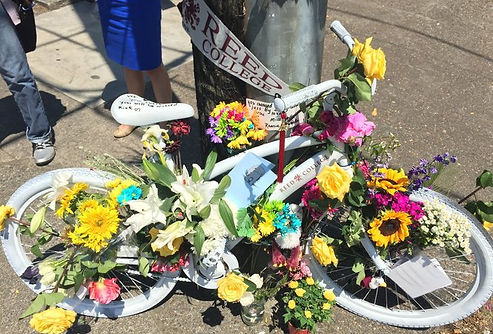
Notes, letters and literary dedications also serve as symbols of intimate mourning. Classmates of Mark Angeles erected a ghost bike at his collision site, and in addition to flowers, they wrote on the bike seat and taped notes of mourning to an electrical pole propping up the ghost bike.. Mark’s classmates also adorned the bike with a banner and graduation tassel from his alma mater, Reed College. Mark’s ghost bike took on both community and intimate mourning symbology right away— flowers illustrating life, personal effects making his existence tangible — which demonstrated the bicycle community seeing another unnecessary death while friends and family grieve over a lost love.
Tracey Sparling’s ghost bike also serves to illustrate the complicated ways the living can memorialize the deceased. In a photograph from March 10th, 2009, personal touches are seen on the bike: a Hello Kitty figure under the bike seat, as well as an R2D2 and cartoon bear figure on the handlebars. These objects are added to assign Tracey’s personality to this ghost bike. A photograph on March 23rd, shows the evolution of Tracey’s bike. Less specific symbols have taken over, with the personal objects replaced by colorful floral arrangements wound around the bicycle, changing it into an overgrown tropical wonderland. The figures on the handlebars have been replaced by an arrangement of eggs connected to circular branches next to paper yellow chickadees sown into white holiday garland. The updated symbols indicate life: colorful, vibrant flowers and birds hatching from eggs. Tracey’s aunt, Susan Kubota, expressed her motivation to make her neice’s bike “pretty”, to help with grief and also assign the bike mementos of Tracey’s creative personality, “Tracey was a bright, beautiful, creative young lady. We wanted to keep it pretty for her” [4,5]. The community, politically charged symbols in Tracey’s bike evolved into personal mementos, which then fully developed into imagery reminding the family and community of beauty and life.
This evolution is not exclusive to Tracey Sparling’s bike. Nick Bucher’s bike begins as a traditional, unadorned ghost bike. His memorial a few days after his death displayed candles, a photograph of him alive, contently drinking, and large letters nailed to a tree saying “XO nick.” Four days later his ghost bike is moved to the crash site. The white bike is colored by a small bouquet of daisies tied to the headset and handlebars, while another set is wound through the back tire spokes. A plastic wrapped bouquet of purple flowers rests below the seat. Over a year later, another photo shows a return to personalizing Nick’s ghost bike by replacing anonymity with a metal bucket mounted on the headset holding a dozen or so daisies. Barely in view, behind the bucket appears to be a sun washed ribbon, the only word visible: Son. The bucket is functioning as a nameplate, and the ribbon represents the bereaved taking ownership over Nick’s ghost bike, at least for a moment. Like Tracey’s family, Nick’s family had taken ownership over the bike over time, decorating it during holidays, his birthday and the anniversary of his death [8]. In addition to the traditional death rituals the ghost bike was added to the family's grief toolkit, acting as a symbol to keep their loved one alive.
Similarly, the ghost bikes of Angela Leazenby and Orion Satushek develop more personality over time. The first photograph taken on March 4, 2006 showing only two white bicycles and a sign saying “A Cyclist Was Killed Here. ghostcyclepdx.org.” The inclusion of the website on the sign, rather than the identity of the deceased illustrates the political ambitions of the memorial and also implies that the people erecting the ghost bikes were not intimately connected to the dead. A photograph taken on August 20, 2006 shows that those close to Angela and Orion have caught up with the political anonymity of the earlier photo. Colorful flowers have been added to the ghost bikes arranged mainly around the tires and handlebars. The cyclist sign is still present, but is balanced out by a stuffed animal and a sachet with indecipherable writing beneath one of the bike seats. The stuffed animal rest against the pole securing the bike, seated on the crossbar, in a pose of patient waiting.

Tracy Sparling - [ ]
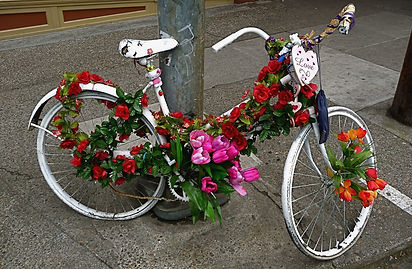

Tracy Sparling - Intimate Mourning in March 2009 [6].
Evolution into generalized symbols two weeks later [7].


Nick Bucher's Memorial on February 6, 2007 [9].
Nick Bucher's Ghost Bike four days later [10].
Signs of intimate mourning when the family takes over [11].

Angela Leazenby's and Orion Satushek's Ghost Bikes displaying typical motifs [1].
A sign and flowers on Tracey Sparling's ghost bike [2].
Mark Angeles' ghost bike [3].

Angela Leazenby's and Orion Satushek's bikes on March 2006 [12].

Angela Leazenby's and Orion Satushek's bikes on August 2006 [13].
[1] Seifert, Brandon. “SE Belmont & 40th Ghost Bike Close-Up.” Flickr - Photo Sharing! Accessed August 4, 2015. https://www.flickr.com/photos/dj10ninjas/321731905/.
[2] Squid Vicious. “Ghost Bike Memorial.” Flickr - Photo Sharing! Accessed August 4, 2015. https://www.flickr.com/photos/fat_hobo/1557808719/.
[3] Oregonian/OregonLive, Tony Hernandez. “Ghost Bike for Mark Angeles.zip.” OregonLive.com. Accessed August 4, 2015. http://photos.oregonlive.com/oregonian/2015/05/ghost_bike_for_mark_angeleszip_3.html.
[4] Kubota, Susan. Personal interview. 12 August 2015.
[5] Ibid.
[6] chrispyworld. “Tracy Sparling Taken on March 10, 2009.” Flickr - Photo Sharing! Accessed August 4, 2015. https://www.flickr.com/photos/chrispyworld/3346305936/.
[7] Maus, Jonathan. “Tracey Sparling March 23, 2009.” Flickr - Photo Sharing! Accessed August 4, 2015. https://www.flickr.com/photos/bikeportland/3383199124/.
[8] Oregonian/OregonLive, David Stabler | The. "Ghost Bikes in Portland: Bittersweet Memorials." The Oregonian. The Oregonian, 2 Mar. 2013. Web. 4 Aug. 2015. <http://www.oregonlive.com/living/index.ssf/2013/03/ghost_bikes_in_portland_a_bitt.html>
[9] Maus, Jonathan. “Ghost Bike - Nick Bucher.” Flickr - Photo Sharing! Accessed August 4, 2015. https://www.flickr.com/photos/bikeportland/382511843/.
[10] Jahat. “Nick Bucher February 10, 2007.” Flickr - Photo Sharing! Accessed August 4, 2015. https://www.flickr.com/photos/jahat/387657608/.
[11] Jahat. “Nick Bucher May 8, 2008.” Flickr - Photo Sharing! Accessed August 4, 2015. https://www.flickr.com/photos/jahat
[12] Jahat. “Angela Leazenby and Orion Satushek - June 25th. 2003.” Flickr - Photo Sharing! Accessed August 4, 2015. https://www.flickr.com/photos/jahat/221547691/.
[13] Jahat. “Angela Leazenby and Orion Satushek - June 25th. 2003.” Flickr - Photo Sharing! Accessed August 4, 2015. https://www.flickr.com/photos/jahat/220475801/.