Portland Ghost Bikes
Why Ghost Bikes?
The use and intention of ghost bike memorials are elastic, serving to express political advocacy, safety awareness, grief, memorialization, and community solidarity. The living’s involvement show various reactions to the lifecycle of the ghost bike, beginning with the cycling community creating and installing a ghost bike, which is then either maintained by the community, neglected or taken over by family and friends, who personally protect the memorial and their loved ones legacy. The memorial can be a positive coping mechanism in a time of detachment toward death. It can also be a valuable tool of warning, reminding drivers to share the road, while also instigating political change. The ghost bike itself most often represents the loss of a physical body, while also serving as the gain of a political body.
Physical Loss and Grieving
The ghost bike memorial is a physical symbol of loss, often used to illustrate an unnecessary death. Premature death is unsettling and irrational, capable of affecting lives even beyond those close to the deceased, serving as a reminder of the inevitability and potential randomness of mortality. The seemingly unnatural circumstances of premature death leaves the grieving with a frustrating and confusing set of emotions. In this makeshift memorial, the ghost bike acts as a surrogate for the body and spirit of the deceased and the casualty site acts as a tangible reminder of life and loss. Hege Westgaard describes this surrogate role in his essay “Like a Trace”: The Spontaneous Shrine as a Cultural Expression of Grief. While looking at makeshift memorials such as ghost bikes, Westgaard recognizes the “practical side of the ritual; to do something beautiful and meaningful, which at the same time can offer peacefulness” [2]. Westgaard goes on to describe the physical symbols, such as flowers and candles, “sort of like a trace” [3].
The makeshift memorial can be a place to express grief in the community of other mourners, giving everyone involved an appropriate and safe place to show emotion. In Virtual Afterlives: Grieving the Dead in the Twenty-First Century, Candi Cann suggests makeshift memorials “offer a way to express one’s grief in a publicly sanctioned way, but without the confrontation of death and the corpse” [4]. Tracey Sparling’s aunt, Susan Kubota, verifies this claim, saying she was “surprised by the comfort the ghost bike provided my sister and I...it was instrumental in helping us through some of the grieving” [5]. Kubota grew attached to the bike over time, only realizing her attachment when McMenamins, the business adjacent to the memorial site, removed the ghost bike [6]. After McMenamins tracked the bike down and returned it to the memorial site, Kubota was “amazed how upset” she was [7]. Kubota also often had to drive through the tragic intersection on her way to work, and admitted that if the ghost bike was not present she would have avoided her usual route [8]. The ghost bike prevented Kubota from looking at the intersection as a site of death.
These memorials also provide specific and useful closure for grief that cannot be processed elsewhere. After Amanda Langworthy’s best friend was killed on her bicycle by an automobile a ghost bike helped her mourn in a way unique to traditional ceremonies: “I mean, I guess Jasmine’s funeral wasn’t really very helpful for me...But we went to her bike and covered it in glitter. Someone brought a stereo and played Jasmine’s favorite music, and we had this little mini-ceremony when we installed it” [10]. The celebratory nature of the memorial employs symbols of the living (bicycle glitter, favorite music) to represent the deceased, while also further hiding conventional symbols of death (body, coffin, headstone).
The makeshift memorial is a powerful grieving tool, providing a unique outlet for family and friends to process the traumatic loss of a loved one. However, the ghost bike memorial would not exist without the intention and effort of an organized, politically charged cycling community motivated by camaraderie and yearning for justice.
The Gain of a Political Body
Carl Larsen is the Engagement Manager for the Portland based Bicycle Transportation Alliance, “a non-profit membership organization working to promote bicycling and improve bicycling conditions in Oregon” [11]. After moving to Portland, Carl become involved in constructing and maintaining ghost bikes, having a hand in some of the Portland area memorial sites. He recognizes the dual purpose of ghost bike memorials, saying they are a “helpful tool for family and friends” as well as “helpful rallying point for riders” supporting the community’s need “to gather around safety concerns and serve as a warning to drivers” [12].
The advocacy nature of ghost bikes are illustrated by Carl’s explanation of their construction. Community volunteers randomly select recycled bicycles, typically painting multiple bikes at a time to build an inventory to replace neglected or damaged sites. Ideally, once a ghost bike memorial is erected it is maintained by someone in the cycling community who lives nearby. This person’s obligation was to preserve the “bare minimum” - keep the area clean and repair any overt damage [13]. In an interview with The Oregonian from 2013, Larson explained that “most families are not aware of the program,” and that the existence of the ghost bikes are a ‘community response” [14]. Personalization, Carl told me, did not happen unless the family got involved or took over management of the memorial [15].
Bicycling has a politically charged history. Health and environmental issues motivate the bicycling community to be organized and active, with the threat of physical harm charging both causes. In the introduction to One Less Car, Zach Furness quotes Sara Stout, a Portland bicycle advocate, “At first bicycling is utilitarian, it’s just how you choose to get around…but it becomes political really quickly because it’s hard to get around. There are difficulties at every day turn, and there seem to be injustices at every turn” [17]. Within the cycling community, the ghost bikes have significant political power. Advocates in San Francisco claimed the lack of ghost bikes in the city was due to the strong, ingrained voice for cyclists from the SF Bike Coalition, stating “there is less feeling that a statement needs to be made” [18]. In 2005, Seattle cycling advocates anonymously placed white bicycles around the city at sites where collisions or threatening conditions were reported, hoping to “ prevent some accidents in the future" [19]. And in Boise, after the Ada County Highway Commission instituted regulations on ghost bike memorials, cycling advocates grew concerned that the new rules would constrain the ability to erect memorials [20]. Boise Bicycle Project Founder Jimmy Hallyburton acknowledged the dual purpose of memorials, “We [at BBP] think they're an effective way of memorializing the people and saying, 'Hey, people are dying on the streets'" [21]. One of the main concerns with the new regulations were centered around the requirement that only the family can apply for a protected ghost bike memorial. This extended even to a member of Ada County Highway Commission Bicycling Advisory Committee. Lisa Brady worried that “ghost bikes reflect the sometimes deadly relationship between motorists and cyclists. The rule, she said, renders cyclists' side of that relationship invisible. Her qualm is that families aren't always cognizant of the symbolic value of ghost bikes” [22].
Families are generally supportive or indifferent to ghost bike memorials. During the research for this project there was little evidence found indicating a negative attitude toward the ghost bike memorial by the family of the deceased. One case was found in Kate Sweeney’s American Afterlife, where multiple personal beliefs and emotions resulted in a family dismantling the ghost bike of their deceased son: “Brian’s family didn’t like the ghost bike, though. They said is 'intruded on their grief.' It turns out that Brian himself had held an especial dislike for roadside memorials; furthermore, his family didn’t want to drive past the spot where he’d died and see such a manifest reminder of the tragedy for years to come” [23].
The majority of Portland ghost bikes analyzed did not take on personal symbols, instead typically displaying generalized community symbols: flowers, candles, and "cyclist struck here" warning signs. These symbols are likely a result of the cycling community, rather than the family, erecting these memorials. The dual functionality of the ghost bike as a makeshift memorial illustrates the complicated nature of modern death, where the loss of life is mourned by the living, who simultaneously strive to use the tragic experience to prevent further tragedy. Though Susan Kubota discussed the emotional uses of her niece’s ghost bike memorial, she cites the memorial and its large community effect as a source of motivation for her to become active in bike and street safety advocacy, working with local and statewide officials and legislators as well as individuals fighting for bike safety [24]. Tracey’s death, along with Brett Jarolimek’s short after, also resulted in Portland city officials making regulatory, structural and educational improvements to prevent additional bicycle casualties. The Green Box is the most prominent example, protecting the cyclist from the dangerous right hook collision.
A letter from Brett Jarolimek’s ghost bike thief also indicates the view that the ghost bike is for living, for advocacy. A note left on the returned bike states: “I knew that there is a war between pedestrians - bicyclists and automobiles and what I did constitutes as high treason, and for this I am truly sorry,” and “that your efforts have impacted at least one life: mine” [26].
The community foundation of the ghost bike memorials, cycling’s advocacy history and the political success of the memorials and their attached protests, give strength to the social intent of the white bicycle. Over the last few years Carl Larsen has observed the fracturing of the ghost bike community, seeing many neglected bikes around town and little organization toward maintenance [28]. The bikes still held in good condition are solely maintained by the family. He suggests that a growing, more mainstream cycling community is a result, which lacks the political energy of the early groups. There is another explanation, however. Bicycle deaths have decreased in Portland after reaching a high of four in 2009 [29]. Without tragedy the advocates have settled into the movements of their daily lives.
[1] Maus, Jonathan. “Community Gathering for Kathryn Rickson-35.” Flickr - Photo Sharing! Accessed August 4, 2015. https://www.flickr.com/photos/bikeportland/7224974660/.
[2] Westgaard, Hege. ""Like a Trace": The Spontaneous Shrine as a Cultural Expression of Grief." Spontaneous Shrines and the Public Memorialization of Death. Ed. Jack Santino. New York: Palgrave Macmillan, 2006. 151. Print.
[3] Ibid.
[4] Cann, Candi K. "The Bodiless Memorial." Virtual Afterlives: Grieving the Dead in the Twenty-first Century. 18. JSTOR. Web. 4 Aug. 2015.
[5] Kubota, Susan. Personal interview. 12 August 2015.
[6] Ibid.
[7] Ibid.
[8] Ibid.
[9] Francis, Jamie. “Memorial jpg.” The Oregonian. 4 Aug. 2015. <http://blog.oregonlive.com/oregonianextra/2007/10/from_the_oregonian_of_friday.html>
[10] Fletcher, Jordan. "Where Cyclists Once Rode, Ghost Bikes Stand Vigil."NPR. NPR, 21 Aug. 2012. Web. 4 Aug. 2015. <http://www.npr.org/2012/08/21/159560603/where-cyclists-once-rode-ghost-bikes-stand-vigil>
[11] Larsen, Carl. Personal interview. 7 August 2015.
[12] Ibid.
[13] Ibid.
[14] Oregonian/OregonLive, David Stabler | The. "Ghost Bikes in Portland: Bittersweet Memorials." The Oregonian. The Oregonian, 2 Mar. 2013. Web. 4 Aug. 2015. <http://www.oregonlive.com/living/index.ssf/2013/03/ghost_bikes_in_portland_a_bitt.html>
[15] Larsen, Carl. Personal interview. 7 August 2015.
[16] Maus, Jonathan. “Community Gathering for Kathryn Rickson-17.” Flickr - Photo Sharing! Accessed August 4, 2015. https://www.flickr.com/photos/bikeportland/7224962286/.
[17] Furness, Zachary Mooradian. "Introduction." One Less Car: Bicycling and the Politics of Automobility. Philadelphia: Temple UP, 2010. 5. JSTOR [JSTOR]. Web. 4 Aug. 2015.
[18] “Ghost Bikes for Dead Riders Run Afoul of Law.” Utne. Accessed August 4, 2015. http://www.utne.com/community/ghost-bikes-for-dead-riders-run-afoul-of-law.aspx.
[19] Dizon, Kristin. "'Ghost Bikes' Offer Eerie Reminder to Share the Road."Seattlepi.com. N.p., 2 Aug. 2005. Web. 4 Aug. 2015. <http://www.seattlepi.com/local/article/Ghost-bikes-offer-eerie-reminder-to-share-the-1179751.php>
[20] Berry, Harrison. "Roadside Distractions: ACHD Memorial Plan Turns Heads." Boise Weekly. Boise Weekly, 24 June 2015. Web. 4 Aug. 2015. <http://www.boiseweekly.com/boise/roadside-distractions-achd-memorial-plan-turns-heads/Content?oid=3513596>
[21] Ibid.
[22] Ibid.
[23] Sweeney, Kate. "Chapter Eight." American Afterlife: Encounters in the Customs of Mourning. Athens: U of Georgia, n.d. 190. ProQuest Ebrary. Web. 9 Aug. 2015.
[24] Kubota, Susan. Personal interview. 12 August 2015.
[25] The Oregonian.“Bike Box Portland.” The Oregonian. 4 Aug. 2015. <http://www.oregonlive.com/portland/index.ssf/2010/09/portland_plans_11_new_green_bi.html>.
[26] Maus, Jonathan.“Brett J Thief Note February 15, 2008.” Flickr - Photo Sharing! 4 Aug. 2015. <https://www.flickr.com/photos/bikeportland/2267555868/>.
[27] Ibid.
[28] Larsen, Carl. Personal interview. 7 August 2015.
[29] "The City of Portland, Oregon." Safety Vision Zero RSS. N.p., n.d. Web. 4 Aug. 2015. <http://www.portlandoregon.gov/transportation/40390>.

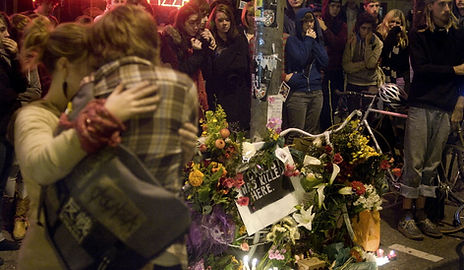


Grief during Kathryn Rickson's Memorial [1].
Grief during Tracey Sparling's Memorial [9].
Advocates gather during Kathyrn Rickson's Memorial [16].
Finishing a green box in Portland, OR [25].
A note left on Brett Jarolimek's bike after it was returned [27].